Artificial intelligence is moving rapidly from experimentation to practical use in finance.
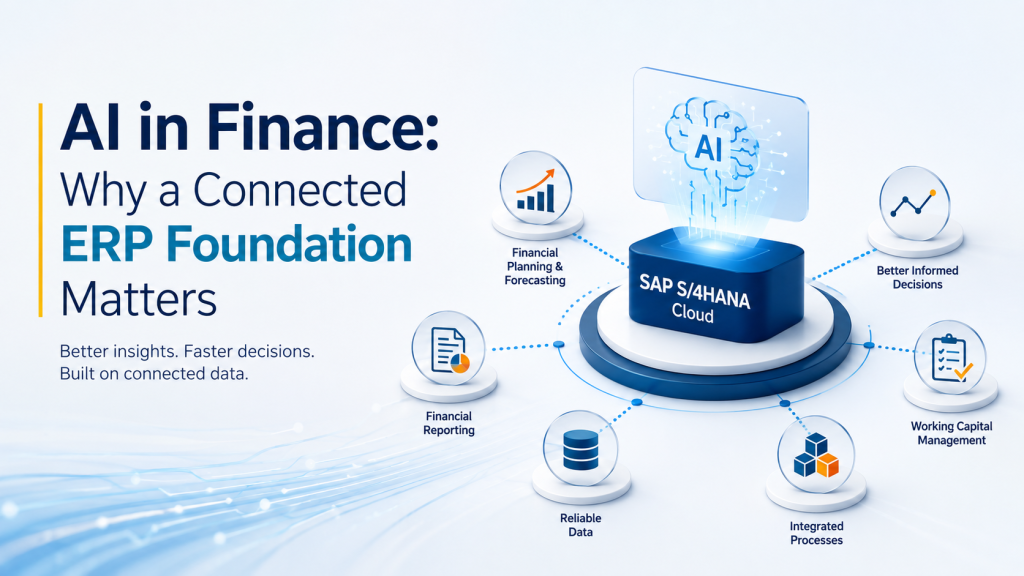
Businesses are exploring how AI can support forecasting, financial reporting, working capital management and faster decision-making. However, the value of artificial intelligence depends heavily on the systems and data beneath it.
For finance teams working with disconnected applications, inconsistent data or ageing technology, adding AI will not necessarily resolve the underlying problem. If information remains fragmented or slow to access, the insights produced may still arrive too late or lack the context needed to support confident decisions.
AI readiness is therefore not simply about adopting new tools. It starts with establishing a connected technology foundation that provides finance with access to reliable data from across the business.
Finance teams are under pressure to respond faster
Finance leaders are operating in an environment shaped by economic uncertainty, inflationary pressures, supply-chain disruption and changing trade policies. These conditions make forecasting, scenario planning and financial flexibility increasingly important.
An April 2026 IDC analyst brief, AI-Powered Cloud ERP for Finance, sponsored by SAP, highlights both the external pressures facing finance teams and the internal technology problems that can restrict their response. Finance professionals told IDC that they often lack the necessary functionality, a common data repository or well-integrated tools.
The result is an information lag that can affect financial planning, investment decisions and the speed at which a business responds to disruption. This is not simply an IT issue. It can influence day-to-day decisions concerning working capital, cash flow, customer payments, supplier terms and cost control.
The need for modernisation is also becoming increasingly difficult to postpone. IDC reports that 70% of respondents to its 2024 Application Services Survey said their application portfolio either required modernisation immediately or would require it within five years.
AI adoption in finance is already accelerating
AI is no longer a distant consideration for finance departments. According to IDC’s 2024 CFO Survey:
- 96% of respondents were already using or piloting AI technology within finance; and
- 81% of those that had implemented or piloted AI believed it had made a positive impact, while the remainder considered it too early to assess.
Different forms of AI are supporting different types of financial work. Traditional AI and machine learning can contribute to historical analysis, working capital management and predictive forecasting. Generative AI can assist with areas such as contract analysis, financial research and ad hoc reporting. Agentic AI is emerging as another potential way to automate and coordinate finance activities.
Interest in agentic AI is particularly strong in two areas. The IDC brief states that 62% of finance professionals were interested in using it for financial reporting, while 58% were interested in budgeting and forecasting.
However, these technologies do not operate in isolation. Their usefulness depends on their access to accurate, current and sufficiently comprehensive business data.
Why adding AI to disconnected systems is not enough
It is possible to introduce AI alongside traditional applications, but this does not remove the delays and inefficient data access created by an outdated or fragmented technology environment.
Finance rarely operates independently from the rest of the business. A sudden change in customer demand may affect supply-chain planning, workforce requirements, procurement decisions and financial projections at the same time. If each function relies on separate data and applications, the business may struggle to understand the full impact quickly.
An integrated ERP platform can provide a shared foundation across these processes. Instead of drawing information from multiple disconnected sources, finance teams can work with data linked to the wider operation. AI capabilities can then use this connected context to support more relevant analysis, faster reporting and better-informed decisions.
The distinction matters: AI can help a finance team process and interpret information more efficiently, but it cannot compensate for missing, inconsistent or inaccessible data.
What does finance need from an AI-ready ERP foundation?
The IDC brief identifies several qualities businesses should look for in a modern cloud ERP. Three are particularly important to the use of AI in finance.
Connected, reliable data
Finance teams need access to data that is broad enough to reflect activity across the business and sufficiently reliable to support important decisions. Connecting financial and operational information can reduce silos and provide a clearer view of current performance.
Embedded intelligence
AI and analytics are more useful when they are incorporated into the processes and applications where work takes place. Embedded capabilities can make insights more accessible to finance users without requiring them to move continually between separate tools.
Integration that can scale
The platform should connect finance with other business functions and support the organisation’s immediate priorities while allowing further capabilities to be introduced as requirements grow. This gives AI access to wider business context without requiring the organisation to replace its underlying ERP foundation as it develops.
Together, these capabilities create the conditions in which finance teams can use data, analytics and AI more effectively. For SMEs considering SAP Cloud ERP, SAP Cloud ERP for Growing Businesses: 7 Common Questions Answered provides practical guidance on cost, implementation times, fit-to-standard, internal resource requirements and industry suitability.
A practical starting point for growing businesses
Becoming AI-ready does not mean attempting to transform every finance process at once. A more practical starting point is to identify where slow, incomplete or disconnected information has the greatest effect on financial performance.
This may include:
- forecasting and scenario planning;
- financial reporting;
- working-capital visibility;
- accounts receivable and customer payment performance;
- accounts payable and supplier payment planning; or
- access to operational data needed for financial decisions.
Businesses can then assess whether their existing applications, integrations and data provide the foundation required to improve these areas. This makes it possible to define the ERP and AI requirements around genuine operational priorities rather than adopting technology without a clear use case.
How SAP Cloud ERP can provide the foundation
SAP S/4HANA Cloud Public Edition brings core business functions, including finance, procurement, sales and service, into an integrated cloud ERP environment. It provides real-time data access, embedded analytics and machine learning capabilities, while using standardised SAP best-practice processes to support a more structured implementation.
The sponsor message accompanying the IDC brief positions SAP GROW as an approach that enables growing companies to begin with priority areas such as finance, supply chain, or HR and to activate broader capabilities as the business grows. This reflects one of the report’s central requirements: a business should be able to start with a focused scope and expand its ERP environment as its needs evolve.
Build the foundation before pursuing the promise of AI
AI has considerable potential to help finance teams work more efficiently and respond more quickly. But its effectiveness depends on the quality, accessibility and context of the information it uses.
For growing businesses, a modern cloud ERP can provide the connected data, embedded intelligence and scalability needed to support both today’s finance priorities and future AI use cases. The objective should not be to adopt AI for its own sake, but to create a finance environment in which better information leads to faster, more confident decisions.
As an experienced SAP Gold Partner, On Device Solutions can help your organisation assess whether SAP S/4HANA Cloud Public Edition provides the right foundation for a more connected, scalable finance function and future AI use cases. Get in touch with us to explore the best solutions for your business.