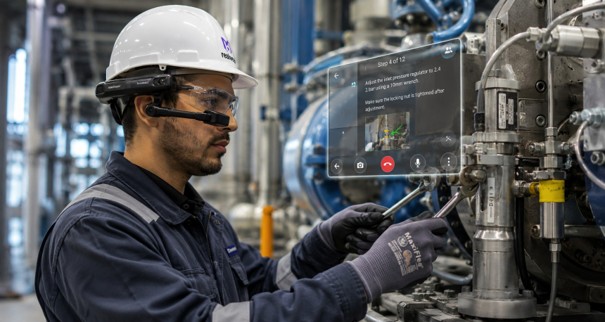
How SAP’s embedded AI capabilities in PM, EAM, and S/4HANA are reshaping maintenance strategies, reducing downtime, and driving measurable ROI across asset-intensive industries.

Asset-intensive industries — manufacturing, utilities, oil and gas, transportation — have long wrestled with the core tension of asset management. How do you keep critical equipment running while controlling maintenance costs? Traditionally, this meant choosing between reactive maintenance (fix it when it breaks) or rigid time-based preventive maintenance, both carrying high hidden costs.
SAP’s portfolio has evolved substantially with the integration of AI and machine learning across Plant Maintenance (PM), Enterprise Asset Management (EAM), and the Intelligent Asset Management (IAM) suite. These capabilities, delivered natively within SAP S/4HANA and via the SAP Business Technology Platform (BTP), represent a paradigm shift — moving organisations toward truly predictive and prescriptive asset strategies.
This article explores key AI use cases available today within the SAP ecosystem, grounded in SAP best practice frameworks.
Core AI Use Cases Across the Asset Lifecycle
SAP’s Intelligent Asset Management suite covers four interconnected solution areas. The following use cases are embedded within the SAP standard – with pre-built AI scenarios available out of the box or via SAP AI Core on BTP.
| Use Case | SAP Solution | Category |
| Predictive maintenance | SAP Predictive Asset Insights | Predictive |
| Anomaly detection on sensor data | SAP IoT + SAP AI Core on BTP | ML |
| Work order authoring via natural language | SAP Joule in S/4HANA | Generative AI |
| Failure mode classification | SAP AI Core (PM notification ML) | ML |
| Spare parts demand forecasting | SAP IBP for Supply Chain + AI | Analytics |
| Conversational asset search and diagnostics | SAP Joule | Generative AI |
| Asset health scoring dashboards | SAP Analytics Cloud + S/4HANA | Analytics |
1. Predictive Maintenance with SAP Predictive Asset Insights (PAI)
SAP Predictive Asset Insights ingests IoT sensor data via SAP IoT or third-party sources to train ML models that predict equipment failure windows. These predictions trigger automated work orders in SAP PM before failure occurs — replacing calendar-based schedules with condition-driven interventions.
2. Anomaly Detection on Sensor Time-Series Data
Unsupervised ML models deployed on BTP detect deviations from normal operating ranges — vibration, temperature, pressure — and surface alerts in the SAP Fiori maintenance cockpit. Technicians receive early warning notifications with severity scoring, enabling prioritised response.
3. Generative AI for Work Order Authoring (SAP Joule)
SAP Joule, embedded in S/4HANA, enables technicians to describe fault symptoms in natural language. Joule auto-generates structured work orders, populates long texts, and suggests task lists drawn from historical maintenance records — reducing administrative overhead by up to 40%.
4. Intelligent Failure Mode Classification
AI classification models trained on PM notification history automatically tag incoming notifications with root-cause failure codes. This reduces manual coding effort, improves data quality, and generates cleaner labelled datasets for future ML training cycles.
5. AI-Assisted Spare Parts Demand Forecasting
SAP Integrated Business Planning (IBP) for Supply Chain combines historical consumption data, maintenance schedules, and predictive failure signals to forecast MRO demand. This reduces both stockouts and excess inventory holding costs.
6. Conversational Asset Search and Diagnostics (SAP Joule)
Technicians ask Joule natural language questions — for example, ‘Show all open notifications on Pump P-102 in the last 90 days’ — and receive context-aware answers without navigating complex Fiori menus. Joule draws on live S/4HANA data to surface relevant maintenance history, pending tasks, and spare parts availability.
7. Asset Health Scoring Dashboards in SAP Analytics Cloud
Composite AI-generated health indices — combining condition monitoring data, maintenance history, age, and criticality weighting — are visualised in SAP Analytics Cloud dashboards. Planners can drill through from portfolio-level health views to individual functional location details in S/4HANA.
SAP AI Foundation and BTP: The Platform Underneath
SAP AI Foundation is the new unified operating system for all SAP Business AI, consolidating the generative AI hub, Joule Studio, SAP Document AI, and SAP Knowledge Graph under a single governed platform. For asset management programmes, three capabilities are particularly significant:
SAP Knowledge Graph as the AI grounding layer. The Knowledge Graph connects 450,000+ ABAP tables, 80,000 CDS views, and key EAM data models — giving AI agents the semantic context to distinguish a functional location from a measuring point without hallucinating entity relationships. Activating the Knowledge Graph early in an EAM AI programme significantly improves Joule output accuracy.
SAP HANA Cloud vector engine. Native vector embeddings in HANA Cloud enable semantic search across maintenance history and notification texts. Technicians and agents can find relevant historical fault patterns using natural language queries — not just keyword filters — dramatically improving diagnostic speed.
SAP-RPT-1 relational foundation model. SAP’s own enterprise foundation model is pre-trained on structured enterprise data and optimised for S/4HANA workloads. For EAM use cases such as time-series forecasting and failure classification, SAP-RPT-1 reduces the need for specialist ML expertise to get production-quality results.
| Layer | SAP Capability | Role in EAM AI Delivery |
| Data | · SAP Business Data Cloud
· SAP Datasphere · SAP HANA Cloud (vector and knowledge graph engine) |
Unified governed data fabric for IoT sensor streams, ERP master data, and third-party OT data. HANA Cloud vector engine enables semantic maintenance history search. Knowledge graph auto-generates asset entity relationships. |
| AI Services | · SAP AI Core
· SAP AI Foundation · Generative AI Hub · Joule Studio · SAP-RPT-1 foundation model |
Train, deploy, and monitor custom predictive models. Access 100+ LLMs via the generative AI hub. SAP-RPT-1 is optimised for structured enterprise data, enabling time-series forecasting without specialist ML expertise. |
| Application | · SAP S/4HANA PM/EAM
· SAP APM (Asset Health + Asset Strategy) · SAP IBP · Clean Core (A–D Rating) |
AI outputs are consumed as standard S/4HANA processes. Clean Core principle and A–D Rating Extensibility Model ensure AI extensions remain upgrade-safe across future FPS releases. |
| Experience | · SAP Joule (2,100+ skills)
· Joule Agents · SAP Fiori 3.0 Horizon · SAP Analytics Cloud · SAAM Mobile · M365 Copilot |
Agentic AI accessible via Fiori desktop, mobile, and Microsoft 365 Copilot. Joule Studio enables custom EAM agents. Joule Insight Cards on My Home provide real-time asset risk visibility. |
SAP Best Practice: The Maintenance Strategy Optimisation Cycle
SAP’s recommended approach follows a continuous closed-loop cycle — often described as the “sense, analyse, act, optimise” model within the SAP IAM best practice framework:
- Sense — Connect Assets and Ingest Data
Onboard IoT sensors and connect them via SAP IoT or third-party edge devices. Stream time-series data into SAP HANA Cloud for real-time processing and historical storage. Establish master data governance for functional locations and equipment in S/4HANA before ingesting sensor data.
- Analyse — Train and Deploy AI Models
Use SAP AI Core to train predictive failure and anomaly detection models on historical data. Validate model performance in SAP AI Launchpad and deploy to production endpoints consumed by SAP Predictive Asset Insights. Establish confidence thresholds and acceptance criteria before go-live.
- Act — Trigger Maintenance Processes
AI-generated alerts automatically create PM notifications or work orders in S/4HANA, route them through the standard approval workflow, and schedule them against available technician capacity via PP/PM integration. Joule assists planners in reviewing and prioritising AI-generated recommendations.
- Optimise — Continuously Improve Models
Completed work order outcomes feedback as labelled training data into the AI pipeline — improving model accuracy over time and enabling automated retraining triggers in SAP AI Core. SAP AI Launchpad provides model drift monitoring and performance dashboards for ongoing governance.
SAP Predictive Asset Insights delivered a 35% reduction in unplanned downtime
and a 20% improvement in maintenance cost efficiency within 18 months of deployment,
achieved by integrating condition-monitoring data directly with S/4HANA PM processes.

— Representative outcome from SAP reference customer benchmark, manufacturing sector
Business Impact Benchmarks
Based on SAP customer success studies and Gartner industry benchmarks for AI-enabled EAM:
| Business Metric | Improvement Range | Source |
| Reduction in unplanned downtime | 30–45% | SAP / Gartner EAM Benchmark |
| Lower overall maintenance costs | 5–8% | ASUG S/4HANA EAM Study 2025 |
| Decrease in asset downtime incidents | 10–15% | SAP Customer Success Data |
| Productivity uplift with Joule AI | Up to 75% | SAP Sapphire 2025 |
| Reduction in compliance penalties | 5–10% | SAP EAM Reference |
| Faster work order authoring with Joule | ~40% | SAP EAM AI Feature Benchmarks |
Key Considerations for Implementation
Based on SAP Activate methodology and field experience, successful AI asset management programmes address three critical areas before going live:
Data quality and completeness — AI models are only as good as the training data. Organisations must invest upfront in cleansing SAP PM master data: functional locations, equipment master records, task lists, and historical notification and work order data. A data maturity assessment against SAP’s IAM data model is strongly recommended as a first step.
Change management for maintenance teams — Shifting from time-based to predictive maintenance requires buy-in from planners, technicians, and operations managers. SAP’s User Adoption Enablement programme and role-based Fiori UX are critical levers for driving adoption. Co-designing the new process with frontline maintenance staff significantly improves outcomes.
Governance of AI outputs — Establish a confidence-threshold policy: at what prediction confidence score does the system automatically create a work order versus generate an advisory alert requiring human review? SAP AI Launchpad supports model monitoring and drift detection to maintain reliability over time. A defined escalation path for low-confidence predictions is essential.
The Path Forward
SAP’s vision for Intelligent Asset Management — converging IoT, AI, and ERP into a single business process — is no longer aspirational. The components are available today within RISE with SAP and the BTP ecosystem. The organisations seeing the most value are those that start with a targeted pilot (one asset class, one plant), validate the closed-loop model, and then scale confidently.
The AI capabilities are proven. The differentiator now is organisational readiness and the quality of your asset data. Engaging with SAP’s Centre of Excellence for Asset Management — or a certified SAP partner with IAM expertise, like OnDevice Solutions — at the outset of your programme will significantly improve the speed and confidence of your deployment.
Contact us here to find out how we can support your enterprise’s asset management journey.