How agentic AI is quietly changing the way SAP teams review, secure, and modernise their systems.
The Shift Worth Paying Attention To
For the last couple of years, much of the AI conversation in the SAP world has focused on code generation. Type a prompt, get some code. It’s an impressive capability, but not transformative, especially when the generated code references fields and objects that don’t actually exist in your system.
Agentic AI is a different animal; instead of guessing, the agent checks. It connects to your system, reads the real source, runs the real checks, and only then speaks. Think: less chatbot, more experienced consultant who happens to know your landscape cold.
That shift – from “write me something” to “review my system” – is where the business value is. And it’s already here.
What “Agentic” Really Means
Strip away the buzzword, and the idea is simple. The AI has a toolbox – it selects the right tools for your question, chaining them together to produce a grounded answer.
At a high level, the conversation flows like this:
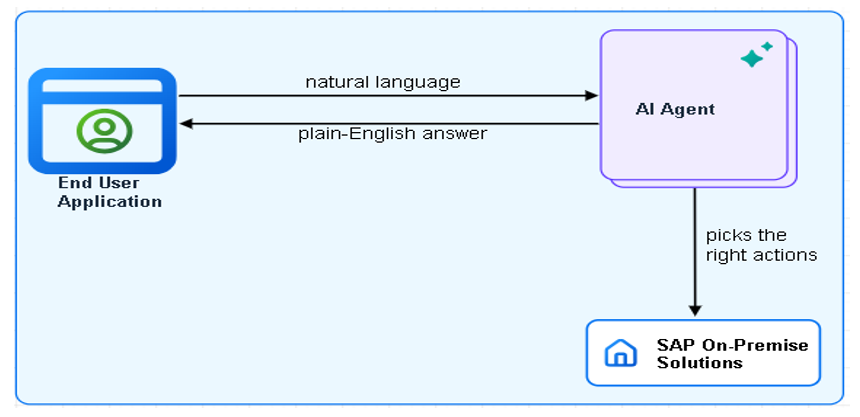
You type a question. The agent decides what to do. Your SAP system responds. The agent stitches it all into something you can read in thirty seconds – no need to know which transactions to open or which tables to join.
And the best part – if the answer needs one action, the agent does one. If it needs five, it does five. You don’t have to choreograph it.
Why SAP has been a tough place for AI
Generic AI may shine in greenfield web apps, but it struggles in SAP because:
- Naming is unforgiving – custom namespaces, three-letter transactions, decades-old conventions.
- Context is enormous – a typical S/4 system has tens of thousands of custom objects, and nobody remembers them all.
- The stakes are high – bad advice here doesn’t just break a demo, it hits finance, logistics, and payroll.
As a result, an agent in this space must do three things well: find the right object, read it accurately, and never make things up. That last one matters most. When the agent’s answer is grounded in a source, it pulls directly from your system, and the hallucination risk drops to near zero.
That’s the promise of agentic AI for SAP teams. Not flashier suggestions but trustworthy ones.
What it looks like in practice
Imagine a typical request from a lead developer or an architect:
“Review this legacy utility class end-to-end. Tell me what's risky,
what's outdated, and where we should focus our clean-up effort.”
A senior ABAPer could absolutely do this. However, it would take them the better part of an afternoon, and by the end, they’d have a stiff neck and a headache. The agent works through it differently:
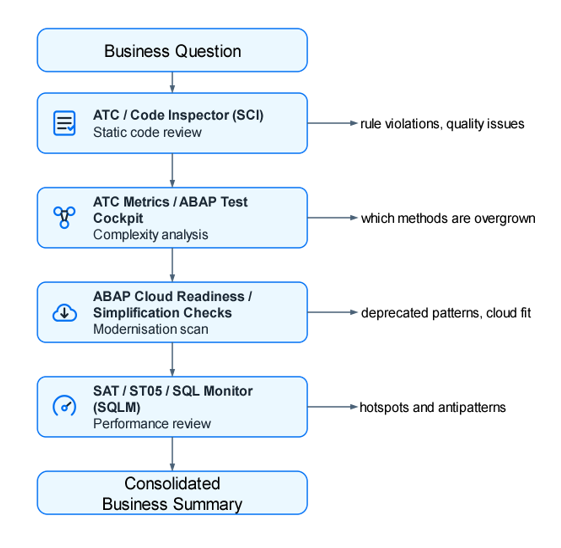
The output isn’t a wall of raw data. It’s a short, direct read-out. Something like:
“This class is about 43,000 lines across roughly 130 methods.
94 of those methods are complex enough to justify refactoring.
It uses 200+ legacy patterns that won't survive a move to ABAP Cloud.
And there are no authorisation checks anywhere in the file – worth a quick chat with Security.”
That’s gold. The developer now knows exactly where to spend their next day. No guesswork, no trawling, no 200-page printout.
Where the business impact becomes visible
When SAP teams start working this way, a few patterns show up quickly.
Faster onboarding
New joiners ask the agent for a tour of a package or a module and get the same walkthrough a senior would give them – on demand, with zero calendar overhead.
Honest code reviews
Peer reviews tend to skim. Agents don’t. They check everything. They find the one SELECT buried inside a loop. They flag the hard-coded password someone added for a weekend and forgot to remove. Boring in the best possible way.
De-risked modernisation
Moving to ABAP Cloud, Clean Core, or BTP? The agent scans an entire custom stack for deprecated patterns, unreleased APIs, and migration blockers in minutes, not months. You still own the decisions, while starting with facts, not hunches.
Always-on governance
Security audits and Clean Core reviews stop being once-a-year events and become something you ask about whenever you feel like it. Continuous, lightweight, and repeatable.
Sharper architectural conversations
When complexity metrics, dependency maps, and performance hotspots take seconds to pull, architecture discussions get crisper. Less “I think…”, more “here are the numbers.”
A simple mental model
Here’s the picture that captures it:
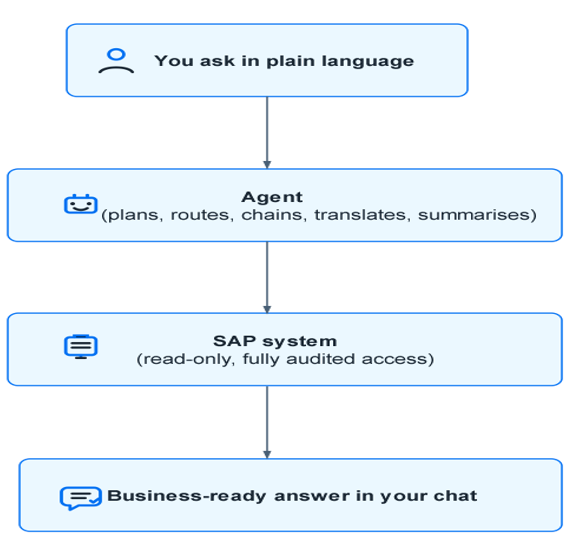
Three things are worth noticing about this picture:
- The AI never bypasses your system’s controls – every action respects the authorisations of the technical user it signs in as.
- Actions are narrow and auditable, with every step logged and reviewable.
- It’s read-only by default: the agent reviews, humans decide and deploy.
What’s next for agentic AI in SAP
Code review is just the first use case. The same pattern fits dozens of everyday SAP workflows:
- Incident triage – the agent reads short dumps, system logs, and relevant source code in one pass.
- Transport coordination – “What’s shipping this weekend and where might it clash?” answered in seconds.
- Release notes – a clear business summary of every change in a given release window.
- Functional QA – reading a data model, running its test suite, and checking coverage in a single interaction.
The exciting bit isn’t any single capability. It’s that once you have a trustworthy agent-to-SAP bridge, adding new capabilities becomes fast and low-cost.
Agentic AI in SAP isn’t magic. It’s only as good as the authorisations you grant it, the quality of the questions you ask, and the discipline around how results are acted on.
But here’s what matters – none of those are hard problems. None require a landscape redesign. They simply need some practice and sensible guardrails. Teams that have started are already seeing the return on their investment.
We’ve spent decades teaching people to navigate SAP through transactions, editors, and endless clicks. Then modern tooling improved the developer experience.
Now agentic AI offers something different: plain English and a capability that feels like a teammate who, unlike the rest of us, genuinely doesn’t mind reading forty thousand lines of legacy code at two in the morning.
If you’re exploring how this could fit into your SAP landscape, we would be happy to share what we’re seeing in practice – get in touch with us here.