The industrial landscape is entering a new era, Industry 5.0, where progress is defined not by automation alone, but by meaningful collaboration between people and intelligent machines.
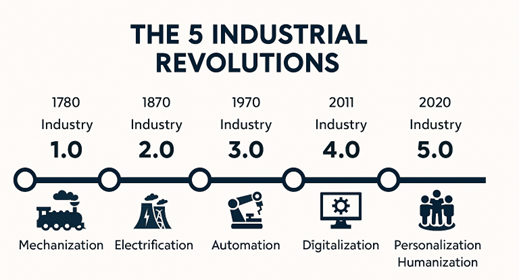
The next phase of industrial evolution focuses on enhancing human capabilities, enabling employees to work smarter, more safely, and more effectively with technology by their side.
From Automation to Augmentation
Industry 4.0 ushered in an era of automation, streamlining processes, improving efficiency, and allowing machines to take over repetitive, time‑consuming tasks.
Industry 5.0 goes a step further – rather than replacing human intelligence, it aims to amplify it.
Imagine a workplace where machines don’t merely execute instructions but actively support, guide, and collaborate with people. A place where employees aren’t constantly reacting to issues but are empowered to anticipate challenges, apply insight, and make smarter decisions. Most importantly, it’s an environment where technology adapts to human needs rather than forcing people to adapt to technology.
This shift is powered by real‑time connectivity, advanced artificial intelligence, and a strong emphasis on human‑centred design. Together, these elements combine the best of both worlds: human creativity, judgment, and empathy paired with machine speed, precision, and consistency.
We are standing at the edge of a significant transformation in how businesses operate. Over the next decade, Industry 5.0 is set to redefine the modern workplace. It’s no longer just about automation or extracting maximum efficiency from systems; it’s about putting people first. The objective is simple yet powerful: to make work easier, more productive, and ultimately more meaningful for employees.
For years, industries have operated in the age of mass production, where automation and robotics dominated repetitive functions with limited human involvement. Now, a new kind of industrial revolution is taking shape, one that doesn’t seek to replace humans with machines but instead leverages technology to support, enhance, and empower the workforce.
In this blog, we’ll explore what Industry 5.0 truly means for today’s business leaders, how organisations can stay ahead of this evolving landscape, and the ways employees stand to benefit from a more human‑centred approach to innovation.
What Makes Industry 5.0 Different?
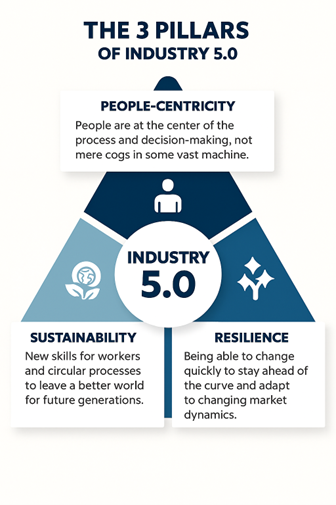
| Feature |
Description |
| People Centricity | Ultra-fast networks like 5G and upcoming 6G enable instant data exchange, allowing real-time decision-making. |
| Sustainability | Smart monitoring systems reduce energy waste and optimise resource usage, making industries more environmentally friendly. |
| Resilience | Flexible systems can quickly adapt to disruptions, ensuring smooth operations and business continuity. |
| Human-Machine Collaboration | Collaborative robots (cobots) and intelligent devices work alongside humans, enhancing productivity without replacing jobs. |
The Power Trio: Wearables, AR, and Mobile
At the centre of this industrial revolution are three powerful technologies: Wearables, Augmented Reality (AR), and Mobile Devices. Together, they are reshaping how work gets done, creating a future where humans are not just operators, but super-enabled decision-makers.
|
Technology |
Description | Key Capabilities |
Example |
| Wearables (Intelligence on the Body) | Wearables have evolved into AI-powered companions that continuously analyse worker conditions and environments, enabling proactive improvements in safety, productivity, and decision-making. | Real-time health, fatigue, and stress monitoring • AI-driven risk prediction and accident prevention • Personalised work-rest and performance optimisation • Context-aware guidance based on worker skill and task |
AI-enabled smart helmets and vests in construction/mining that detect gas leaks, heat stress, and unsafe movements automatically alert both workers and control centres before incidents occur. |
| Augmented Reality (Intelligence in Vision) | AR overlays digital information onto the real world, transforming vision into a powerful decision-making tool. | • Step-by-step repair guidance • Real-time error detection •Interactive training environments • Voice-controlled visual interfaces | A technician sees repair instructions directly on a machine while working. |
| Mobile Devices (Intelligence in Your Pocket) | Mobile devices act as command centres, delivering real-time data, insights, and control to workers. | • Predict machine failures
• Monitor factory performance • Provide smart alerts (only what matters) • Recommend the best actions using AI. |
Factory managers track operations and make decisions instantly from a mobile dashboard. |
The AI Layer: The Real Game Changer
What takes all of this to the next level? Artificial Intelligence.
AI isn’t just another layer of technology; it’s the spark that turns ordinary tools into smart, intuitive companions. Instead of simply following commands, these systems think, learn, and evolve alongside us.
Imagine tools that can spot problems before they even surface, tailor workflows to match everyone’s style, and take over complex decision-making without missing a beat. Even better, they continuously learn from human behaviour, getting sharper and more efficient with every interaction.
In short, AI doesn’t just support work, it elevates it, making everyday processes smarter, faster, and far more human-aware.
AI Use Cases in SAP-Driven Manufacturing
| Technology | Use Case | AI Role |
Outcome |
| Wearables | Worker Safety in Smart Factories | AI monitors vitals, fatigue, and exposure to hazardous conditions, integrated with SAP EHS data | Fewer accidents, real-time alerts, improved compliance with safety regulations |
| Wearables | Smart Ergonomics on Assembly Lines | Motion and posture analysis linked with SAP HR and operational data | Reduced workplace injuries, optimised workforce efficiency |
| AR | AI-Guided Equipment Maintenance | Computer vision detects faults and pulls repair workflows from SAP maintenance modules | Faster repairs, reduced downtime, better asset utilisation |
| AR | Remote Maintenance with SAP Integration | Visual overlays combined with SAP service tickets and asset history | Instant expert support, reduced service costs, improved first-time fix rates |
| Mobile | Real-Time Production Monitoring | Predictive analytics using live data from SAP production systems | Better decisions, proactive issue resolution, improved throughput |
| Mobile | Supply Chain and Logistics Optimisation | AI predicts demand, delays, and optimal routes using SAP supply chain data | Cost savings, faster deliveries, improved planning accuracy |
| Wearables | Operator Productivity and Fatigue Tracking | AI correlates human performance data with SAP production KPIs | Higher efficiency, reduced errors, better workforce planning |
| AR | Employee Training and Digital Work Instructions | AI delivers step-by-step AR instructions linked to SAP process workflows | Faster onboarding, fewer errors, standardised operations |
| Mobile | Inventory and Warehouse Optimisation | AI-powered image recognition + SAP EWM integration for stock tracking | Reduced stockouts, optimised inventory, faster picking/packing |
| Wearables + AR | Hazard Detection in Industrial Plants | AI fuses sensor data with SAP risk management systems to alert workers visually | Proactive risk prevention, safer operations, and reduced downtime due to incidents |
Why This Matters
Industry 5.0 isn’t just chasing efficiency; it’s redefining what work feels like by putting human empowerment front and centre.
Imagine walking into a workplace that adapts to you. Your tools, dashboards, and workflows are tailored to how you think and work best, creating a truly hyper-personalised environment.
On the factory floor, smart systems monitor conditions in real time, flagging risks before they turn into accidents – helping organisations move closer to near-zero safety incidents.
Decision-making becomes faster and sharper, with AI-driven insights guiding workers instead of overwhelming them. Repetitive mental strain fades away as intelligent systems handle the heavy cognitive lifting, allowing employees to focus on creativity, strategy, and innovation. And all of this happens while businesses operate more sustainably, optimising resources without compromising productivity.
That’s Industry 5.0 in action: technology working with people, not against them.
What’s Next? Future Scope
Think beyond wearables that simply count steps or track vitals. Imagine cognitive devices that anticipate your needs, surface insights in the moment, and actively support how you think and work.
Picture AI-powered, AR-enabled workspaces where collaboration isn’t limited by geography, where teams interact, design, and problem-solve together in immersive digital environments.
Now extend that idea further: platforms where humans and AI co-create in real-time. Engineers refining designs alongside intelligent systems, planners solving complex supply chain challenges with AI-generated scenarios, and innovators exploring ideas that evolve dynamically as they work.
At an industry level, operations begin to run with a new kind of autonomy, self-optimising systems that remain anchored in human judgment, creativity, and oversight.
At the centre of it all, AI becomes the connective intelligence – the layer that brings together data from wearables, AR interfaces, and mobile platforms. It learns from human behaviour, adapts continuously, and fine-tunes how work happens quietly, intelligently, and in sync with people.
Industry 5.0 isn’t just another step in industrial evolution. It’s a redefinition of work itself.
It’s the moment when technology stops being just a tool and starts becoming a collaborator – where machines don’t replace human intelligence but extend it.
When efficiency is no longer the only goal, experience, creativity, and purpose matter just as much.
The future of work isn’t about choosing between humans and machines. It’s about unlocking what becomes possible when both work together.
Machines no longer sit on the sidelines, waiting for instructions. They learn, adapt, and contribute right alongside us. The organisations that embrace this collaboration today will help shape the future of the industry tomorrow.
At On Device Solutions, we help organisations implement connected worker technologies powered by SAP, wearables, AR, and mobile solutions.
Contact us to explore how we can help prepare your frontline operations for the Industry 5.0 era.