AI-Powered Field Maintenance: From Predictive Insights to Hands-Free Execution
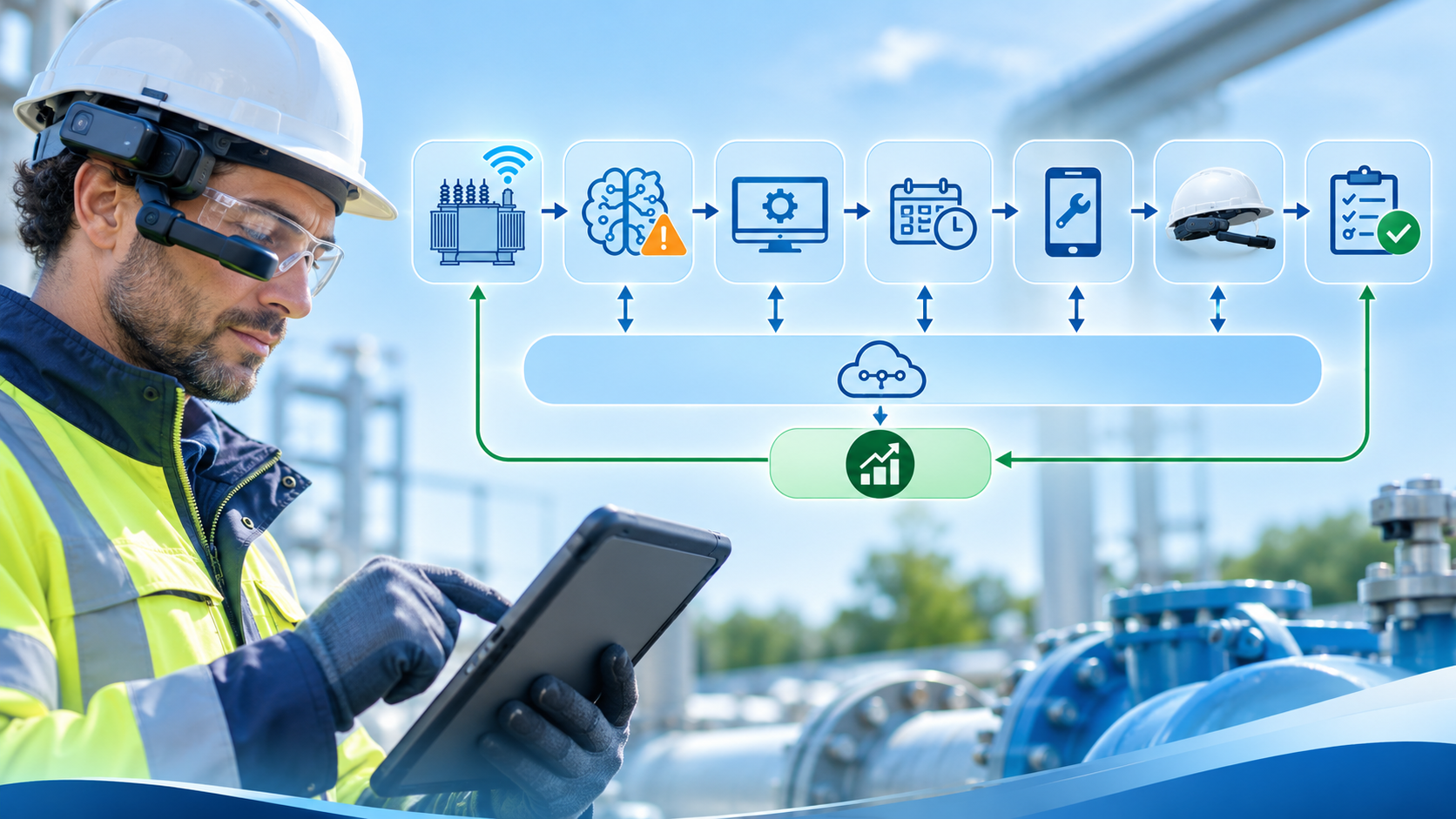
In asset-intensive industries, identifying an equipment problem is only one part of maintaining operational reliability. The real challenge is turning that information into timely action and ensuring that field technicians have everything they need to resolve issues.
Consider an electricity substation where a transformer begins showing unusual temperature variations. The monitoring system detects the change, but what happens next? Someone must investigate the data, arrange an inspection, assign a qualified technician, provide the necessary maintenance information, and record the findings.
If these activities rely on disconnected systems and manual communication, they can waste valuable time.
A connected approach using artificial intelligence (AI), SAP Field Service and Asset Management (SAP FSAM), SAP Service and Asset Manager (SAP SSAM), and RealWear can help streamline this process.
In our earlier article, SAP AI for Asset Management: Beyond Reactive Maintenance, we looked at AI use cases across asset management, including technician support with wearables. This article goes deeper into the technical architecture behind that scenario.
For clarity, we assume the following setup. Maintenance and asset records are managed in an SAP backend such as SAP S/4HANA. SAP FSM plans and assigns the field work. SAP SSAM is the technician’s mobile application for carrying it out. The exact combination will depend on the customer’s SAP landscape.
From Equipment Monitoring to Intelligent Maintenance
The process begins with equipment condition monitoring.
Sensors installed on critical assets collect operational information, including temperature, vibration, pressure, and load. This data can be made available to an AI service for analysis.
Rather than relying only on predefined thresholds, AI models can analyse historical and real-time readings to identify unusual patterns and potential signs of equipment deterioration.
SAP Asset Performance Management (SAP APM) is another option for this analysis, either on its own or alongside an AI service. SAP APM can analyse asset condition and performance data and raise alerts that feed SAP maintenance processes. The right choice depends on the assets, the data available and the customer’s SAP landscape.
For example, an AI service monitoring a transformer may identify a temperature trend that differs from its normal operating behaviour.
The service can generate a structured recommendation containing:
- Equipment identification.
- Detected abnormal condition.
- Relevant sensor readings.
- Time of detection.
- Recommended inspection or investigation.
This recommendation becomes the starting point for the maintenance process.
Importantly, while AI indicates that further investigation may be needed, engineering teams remain responsible for validating the recommendation and deciding on the appropriate maintenance action.
Connecting AI Recommendations with SAP Field Operations
The next challenge is transferring the identified issue into the organisation’s maintenance environment.
This is where enterprise integration becomes important.
An integration service can receive the AI recommendation, validate its contents, and map the information to the appropriate SAP maintenance process.
Depending on the customer’s SAP landscape, this may involve creating or updating a maintenance notification, work order, or service activity through supported APIs.
Once the maintenance requirement is established, SAP FSM can support planning and assignment of the field activity.
The planner considers technician availability, location, qualifications, and job priority before assigning the work. The technician then receives the relevant activity details.
This creates a connection between asset intelligence and operational resource planning: the information generated by monitoring and AI analysis initiates a structured maintenance response.
Bringing SAP Maintenance Information into the Field
When the technician arrives at the substation, the focus shifts from planning to execution.
SAP SSAM provides mobile access to relevant maintenance information, allowing the technician to review the work order, equipment details, and inspection requirements.
During the inspection, the technician can record readings, add observations, capture photographs, and update the maintenance activity.
However, handling a conventional mobile device can be inconvenient when a technician needs to refer to instructions while carrying out a physical task.
This is where RealWear introduces another dimension to the solution.
A hands-free experience with RealWear
RealWear industrial headsets provide a wearable interface designed for hands-free operation in industrial environments.
A compatible application presents relevant work instructions and inspection steps within the technician’s field of view. For example, the technician could follow a guided inspection:
- Confirm the transformer identification.
- Review the approved inspection instructions.
- Check the specified temperature indicator.
- Record the observed reading.
- Complete the inspection checklist.
Voice commands, used to navigate supported workflow steps, reduce the need to handle a separate device.
If an unexpected condition is identified, a remote specialist can provide assistance through a compatible remote support solution such as TeamViewer Frontline.
Depending on the device, application and network configuration, the specialist may be able to view the technician’s perspective and provide visual guidance.
As a TeamViewer Champion Partner, On Device Solutions brings TeamViewer Frontline Assist into the SAP workflow. The integration is pre-built for SAP FSAM and SAP SSAM, so a planner can start a support call from the SAP FSAM planning and dispatching board and review the call report in SAP FSAM.
The expert can annotate the technician’s view, share documents and drawings, and send remote warnings to help avoid accidents. Session details are linked to the SAP record, and data captured in hands-free workflows is synchronised to SAP FSAM and SAP S/4HANA through a certified SAP connector developed by On Device Solutions.
This combination brings maintenance information and specialist knowledge closer to where the work is performed.
Capturing Field Results by Voice: AI-Powered Natural Language Processing
Entering findings by hand is one of the slowest parts of a field job, and it is hardest to do while wearing gloves or holding a tool.
We use AI-powered natural language processing with SAP Dynamic Forms. Instead of typing into individual fields, the technician describes their findings or actions in their own words, and the AI helps turn that description into SAP form entries.
The Technical Architecture: Making the Integration Work
This solution requires a defined integration architecture rather than a direct connection between every individual product. A typical implementation can be organised around the following data flows.
Flow A: Asset monitoring to AI – sensor data is collected through an IoT or asset monitoring platform and made available to an AI service or SAP APM. The AI service or SAP APM analyses the readings and produces a structured recommendation.
Flow B: AI to SAP maintenance – an integration service receives the recommendation and maps the relevant information to the appropriate SAP maintenance object using supported interfaces.
Flow C: SAP FSM and SAP SSAM – the maintenance workflow makes the required work information available for field execution. The integration design defines how work details, asset references, and status updates are exchanged between the relevant SAP applications.
Flow D: SAP information to the wearable application – a compatible wearable application retrieves the required work context through an API or integration service. It presents selected instructions and workflow steps on the RealWear headset, and connects to remote expert support through TeamViewer Frontline Assist.
Flow E: Field results to SAP – inspection results, readings, photographs, and completion information are transferred to the relevant backend systems, including findings captured in natural language through SAP Dynamic Forms. Where connectivity is unavailable, supported offline and synchronisation capabilities must be considered.
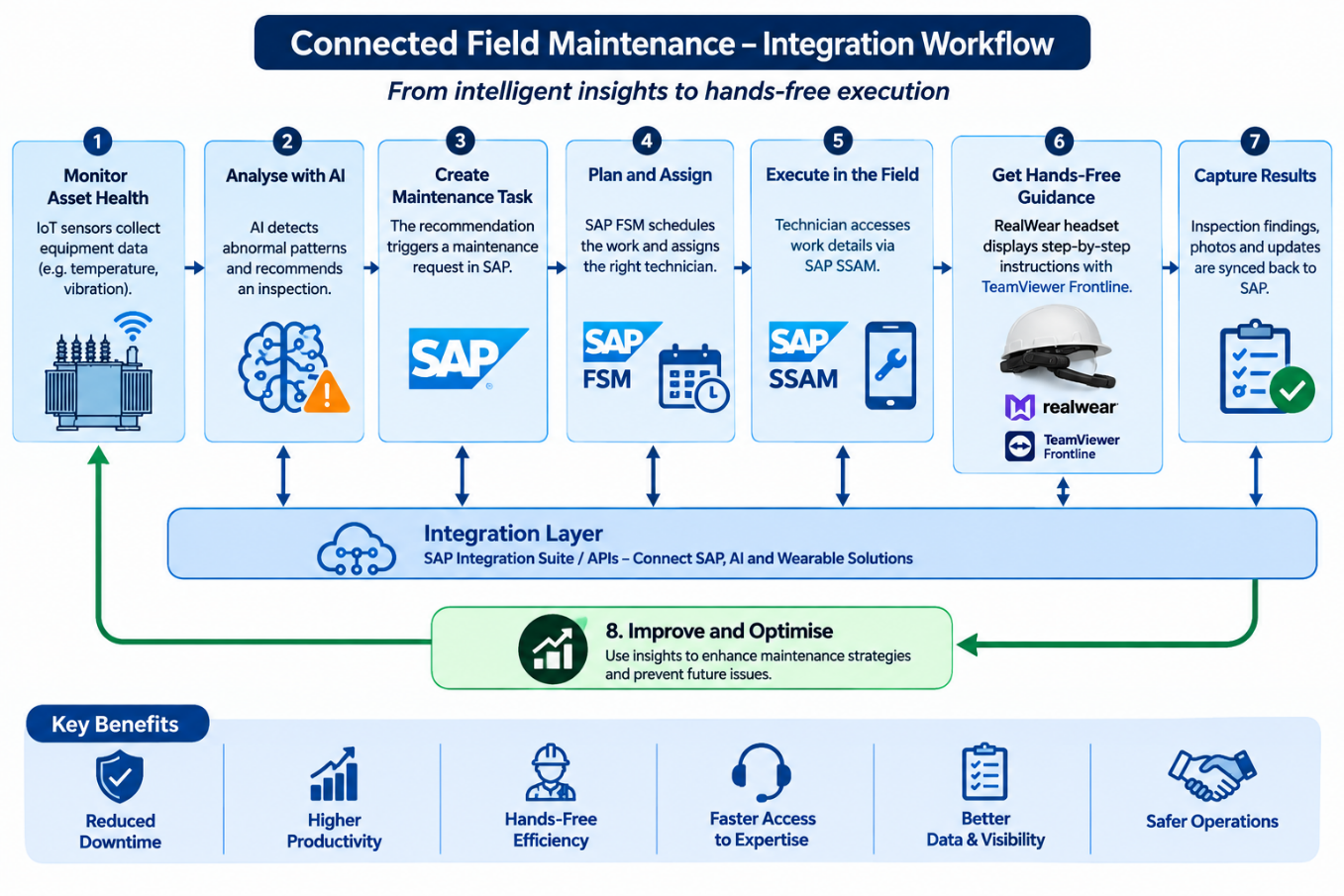
The integration architecture may use SAP Integration Suite, SAP APIs, and other approved middleware or application interfaces. The specific implementation depends on the SAP product versions, available APIs, and the selected wearable software.
One important consideration is that RealWear does not automatically display SAP SSAM screens. A compatible application or specifically developed wearable workflow is needed to present the required information. Similarly, the exact SAP FSAM and SSAM data exchange must be validated against the intended product configuration.
The integration should also include authentication, data mapping, error handling, API monitoring, and synchronisation controls to keep the information consistent across systems.
What Does the Business Gain?
The value of this architecture derives from improving the whole maintenance process rather than introducing individual technologies in isolation.
More proactive maintenance
AI-supported analysis can help maintenance teams identify potential equipment issues earlier and investigate them before they develop into more serious problems.
Less time spent searching for information
Technicians can access relevant work details and guided instructions through connected applications, reducing the need to switch between documents, systems, and communication channels.
Better use of specialist resources
Remote assistance allows experienced engineers to support multiple field technicians without always travelling to each location.
Improved maintenance documentation
Recording inspection findings and supporting evidence during the activity, including by voice and natural language, can improve the completeness of asset history and reduce the need for retrospective data entry.
More efficient field operations
Combining better work planning, accessible information and specialist support helps reduce avoidable delays and improve the likelihood of completing work on the first visit.
Continuous improvement through operational data
Inspection results and maintenance history can provide additional information for future asset analysis, helping organisations refine their maintenance strategies.
These benefits should be measured during implementation. Useful indicators include inspection completion time, repeat visits, remote support response time, maintenance record completeness, and equipment downtime.
Making Connected Field Maintenance a Reality
In conclusion, combining AI, SAP FSAM, SAP SSAM and RealWear creates an opportunity to connect asset intelligence with practical field operations.
Instead of treating equipment monitoring, maintenance planning, mobile execution, and remote assistance as separate activities, organisations can bring them together through an integrated workflow.
AI helps identify potential problems. SAP supports the management of maintenance activities. Wearable applications provide technicians with hands-free access to relevant guidance, while connected backend systems retain the information captured during field execution.
At On Device Solutions, we combine enterprise system integration with tailored software development, including SAP application integration, API-based connectivity, AI-powered workflows, TeamViewer Frontline Assist, AI-powered natural language processing with SAP Dynamic Forms, and wearable applications for RealWear devices. We help turn emerging technologies into practical solutions for real field service and asset management challenges.
Reach out to discuss how connected AI-powered field maintenance could work in your SAP environment.
The next step in field maintenance is not simply collecting more data, but turning it into decisive action where and when it matters most.