SAP Advanced Event Mesh (AEM) offers a strategic shift toward real-time, event-driven communication across cloud, hybrid, and on-premises landscapes.
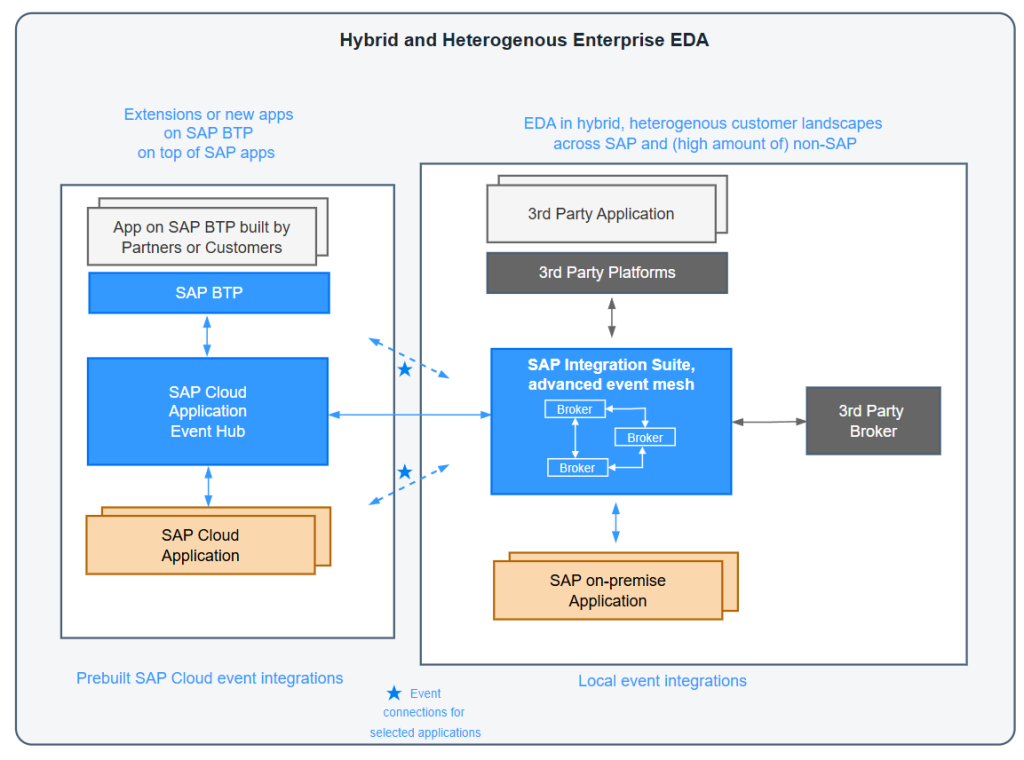
This article introduces the fundamentals of event-driven architecture (EDA) and explores how SAP Advanced Event Mesh (AEM) supports scalable, asynchronous integration across complex IT landscapes. It also highlights how AEM fits into the broader SAP Integration Suite, helping organisations modernise their architecture while reducing dependency on tightly coupled systems.
Why Event-Driven Architecture Should Be on Your Radar
Modern SAP programmes – especially greenfield S/4HANA implementations – increasingly call for real-time responsiveness. Whether you’re deploying SAP in a RISE with SAP model or independently, event enablement is fast becoming a standard design consideration.
Event-driven architecture enables asynchronous, loosely coupled systems that communicate via published events rather than direct API calls. This design provides:
- Greater scalability
- Improved resilience
- Cleaner decoupling of systems
- Faster time-to-action for business users
SAP Advanced Event Mesh: The Enterprise-Grade Event Broker
SAP Advanced Event Mesh (AEM) is SAP’s enterprise-grade event broker, designed to enable event-based communication across SAP and third-party systems.
Built on open standards (e.g. AMQP, MQTT, REST), AEM provides:
- Scalable pub/sub communication
- Real-time event delivery
- Loose system coupling
- Support for hybrid and multicloud deployments
It’s ideal for use cases where real-time data distribution, resilience, and decentralised integrations are key – such as inventory updates, transport booking notifications, or master data replication across global systems.
Common SAP Advanced Event Mesh Use Cases
SAP consultants highlighted several use cases where AEM adds value:
- Master Data Distribution – Reduce duplication of IDoc configurations by publishing changes once, then distributing via AEM to multiple consumers.
- Inventory and Transport Events – Enable instant reactions to stock movements or delivery milestones, improving supply chain visibility.
- Migration Projects – Re-architect existing point-to-point integrations to scalable event-based models as part of PIPO migrations.
AEM vs Traditional API-Based Integration
AEM follows a publish–subscribe (pub/sub) model, differing from traditional request–response integrations (e.g. REST or SOAP APIs). While APIs remain essential, AEM supports event-based push models where systems react to business events – such as an order being placed or a delivery being completed without polling or batch jobs.
This complements API-based integrations and introduces more efficient, scalable and decoupled communication patterns.
Embedded Tools for Visibility and Control
AEM offers advanced tools for governance, monitoring, and deployment, such as:
- Event Portal – To design, manage and catalogue events and event flows
- Distributed Tracing – For tracking event lifecycles across publishers, brokers, and subscribers
- Dynamic Routing and Filtering – To ensure events only reach relevant consumers
- Terraform Support – For infrastructure-as-code deployment
These capabilities help enterprise teams maintain control as the number of event producers and subscribers grows.
Getting Started with AEM
Organisations looking to adopt AEM should:
- Identify candidate use cases for event-driven design (e.g. master data replication, near real-time notifications)
- Assess their SAP landscape for event enablement readiness
- Select the right broker tier – whether starting small with Integration Suite’s basic Event Mesh or scaling up to Advanced Event Mesh for large deployments
- Define architectural patterns that integrate AEM into wider enterprise strategy
How On Device Solutions Can Support Your Enterprise
Our Architecture as a Service (AaaS) offering helps organisations modernise their integration landscapes – including planning and deploying event-driven architecture using SAP technologies, like AEM. We support clients with defining integration architecture, aligning SAP AEM with enterprise-wide digital strategies, and establishing governance for scalable, future-ready systems.
Our services include architecture design, integration landscape reviews, and planning deployments that meet both technical and business requirements, ensuring SAP Advanced Event Mesh fits seamlessly into your broader SAP and non-SAP ecosystem.
Whether you’re exploring event enablement in S/4HANA or looking to replace legacy middleware, On Device Solutions can help you make the right architectural decisions, ensuring your systems are scalable, future-ready, and aligned to your business goals. As part of our broader Architecture-as-a-Service offering, we support clients across strategy, governance, and delivery.
To learn how On Device Solutions can support your AEM or EDA journey, get in touch with our integration experts here or explore our AaaS case study below for real-world insights.
Related case study
As part of a broader Architecture-as-a-Service (AaaS) engagement, we supported a major UK utility provider during a strategic business separation. Our role included delivering independent design assurance aligned with enterprise architecture principles, ensuring consistency and governance across a complex landscape. Download the case study here.